Please bring your Course Reader, and the Beal book if you have it, and/or a laptop. We will be reviewing material from the last half of the class and discussing the format and content of the take-home final exam, which will be opened up on Dec 15, due back by 3:30 pm on Dec 18.
We will also view a 2011 KET television documentary about Furnace Mountain Zen Center, one of the subjects of Beal’s final chapter. Lastly, students will complete a course evaluation.
Your research paper is due tonight by 11:59 pm, uploaded to Blackboard under Content –> Unit 3
Worcester State is cancelled on Monday, Dec 2 due to inclement weather. We will defer our discussion on Course Reader Day 23 (Religion and the Law) to Wednesday, Dec 4 and move our Dec 4 assigned reading (Course Reader Day 24) to Monday, Dec 9.
NOTE that the Day 23 reading has a homework assignment along with it: as you read the articles, make a list of cases *and* the core religious issue at the center of each one. And if you know of other relevant or ongoing court cases that would contribute to our discussion, please bring them to class to share.
I still plan to email you feedback on your paper drafts by the end of the day on Monday, Dec 2.
Mon, Nov 25: Print and bring TWO COPIES of a draft of your paper, for Peer Review Day
After the Thanksgiving Holiday, our last classes will be dedicated to looking at contemporary religious pluralism, polishing your research paper, and preparing for the final exam.
Mon, Dec 2: You will get feedback from Dr. Hangen on your draft by this date, by email. Prepare to discuss Reader Day 23, Religion and the Law
Wed, Dec 4: We’ll discuss Reader Day 24, Pluralism Under Fire *and* Beal, Chapter 5.
Mon, Dec 9: Final version due, uploaded to Blackboard assignment portal by 11:59 pm. In class: Final Exam Prep and course wrap-up.
Our designated Final Exam slot is Wednesday Dec 18 at 12:30 – 3:30 pm, but we are not meeting in person. The final exam will be posted to Blackboard as a take-home exam by Dec 15 and will be due on Dec 18 at 3:30 pm, uploaded to Blackboard.
Instructions for Monday’s Class Nov 18 – “Source Plus”
You have now turned in a topic proposal and have begun researching your chosen topic. On Monday, Nov 18, we will have a roundtable in which each person should present one of the sources they are using for their paper. Due in class: (preferably printed out rather than emailed) a piece of writing about your source, 1-3 pages long, following the criteria below. This piece of writing could end up being a draft for the section of your paper in which you analyze or discuss this particular source, so it’s a helpful intermediate step in the paper-drafting process.
If you are bringing a Primary Source to share:
When was this source created, by whom, and for what purpose?
Describe the source (its contents, its material dimensions if applicable, any other useful descriptors).
Emphasize any specific strengths or weaknesses of this source.
Why did you choose this one to share with the class?
How is it applicable to or useful within your particular project?
How does this source benefit religious historians, or what can we (collectively, in our class) learn about American religious history from it?
If you are bringing a Secondary Source to share: (such as a book or journal article)
Explain title, author, publisher or journal, and date. Help us “meet the author.”
Summarize the abstract or main topics, scope, and purpose of the source.
What does it say? (i.e. what argument is the author making, or what new or interesting information does s/he present?)
What do you think about what it says? (i.e. how is it applicable to or useful within your particular project? Are there specific strengths or weaknesses you’d like to mention?)
Why did you choose this one to share with the class?
How does this source benefit religious historians, or what can we (collectively, in our class) learn about American religious history from it?
To date in this course, I’ve provided materials and topics for your exploration into American religious history. In the final unit of the course, you’ll be conducting your own research project on a topic of your choice, resulting in a 12-15 page research paper. I’ve added new material to the Unit 3 folder on Blackboard for you to use as you work on this project.
Your process begins with a close look at some relevant historiography (if that’s a new word for you … I’ve added a supplemental module in Blackboard under Unit 3) on Wednesday Nov 6, when we discuss Day 18 in the Course Reader, three articles tackling religious historiography from three different perspectives.
I also STRONGLY RECOMMEND everyone have a one-on-one meeting in person (or via Skype) with me between Nov 4-12 to discuss possible topics and approaches.
No class on Monday, Nov 11 — the long weekend should hopefully give you a chance to do a final brainstorm on your topic and what sources you’d like to use.
On Wed Nov 13 we will have a research session in the library with Ross Griffiths, the History library liaison and archivist; hand in your proposal that day as a printed paper.
Monday 10/21 – Course Reader Day 13: 1893, 1965, and 1993 – with a reading to set each date in context, to help understanding the background to religious pluralism in the U.S. and in our city.
Wednesday 10/23 – Debrief Day and Visit Report due. Bring your Site Visit as a printed paper, to be handed in at the end of class after our discussion.
Monday 10/28 – Change to Syllabus – Class Cancelled. We will not hold class on the 28th, I will be out of town. Use the day to make progress on your research, visit(s), or interviews.
Wednesday 10/30 – bring laptops for a working research & writing session for the Microhistory Project
Monday 11/4 – Microhistory Project showcase and presentation day, end of Unit 2
Please remember, as mentioned on the syllabus, to bring laptops to class on Wed 10/16 so we can use them to explore, research, and get started working on the Pluralism Microhistory Project. For more information on the project, see the tabs on Blackboard and the course website.
Our quick tour of American religious history has brought us up to the end of the 19th century and the turn of the 20th, a period in which waves of new immigrants arrived in the United States, many of them Jewish or Catholic from southern and eastern Europe. They brought their religious traditions and cultures, often entering an atmosphere of mutual suspicion about the effect their presence would have on the nation and its existing religious cultures.
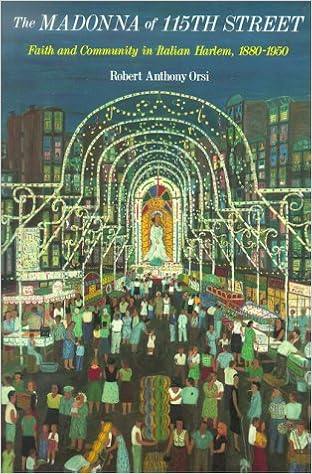
For the next two classes, we will read and discuss Robert Orsi’s masterpiece of religious ethnography, Madonna of 115th Street: Faith and Community in Italian Harlem, 1880-1950, which examines Italian Catholic devotional practices in New York’s East Harlem neighborhood that center on worship of the Virgin Mary. Orsi is a Professor of History and Catholic Studies at Northwestern University.
I posted Discussion Questions for our two class sessions on Blackboard, also here.
You can download these as Word docs and type directly into them as a guide for your notetaking: these are not homework assignments and don’t need to be turned in. They are just assists for your own reading and preparation for class.
Relevant links:
a fascinating 5-minute NPR piece from 2015 about the Madonna of 115th Street’s image being refurbished and what she — and the ritual and cultural practices associated with her — continue to mean for 21st-century New York Italian Catholics in East Harlem.